
THE FOREST JOURNAL · NATURAL HISTORY
A bird can remain hidden while its call fills the forest. Another may cross a gap in the canopy and disappear before its colours become clear. These brief encounters raise questions: what species was it, where does it live, and what can a single sighting tell us? Understanding the birds of Bukit Lawang begins with curiosity, but it also depends on careful records and a clear sense of place.
One landscape, different habitats
A visit to Bukit Lawang explores one part of a much larger landscape. The Leuser Ecosystem extends across Aceh and North Sumatra, with habitats ranging from lowland rainforest and peat swamp to montane forest. These differences matter when talking about birds. A species recorded elsewhere in Leuser should not automatically be expected on a short trek from Bukit Lawang. [1]
Hornbills: a glimpse into the wider rainforest
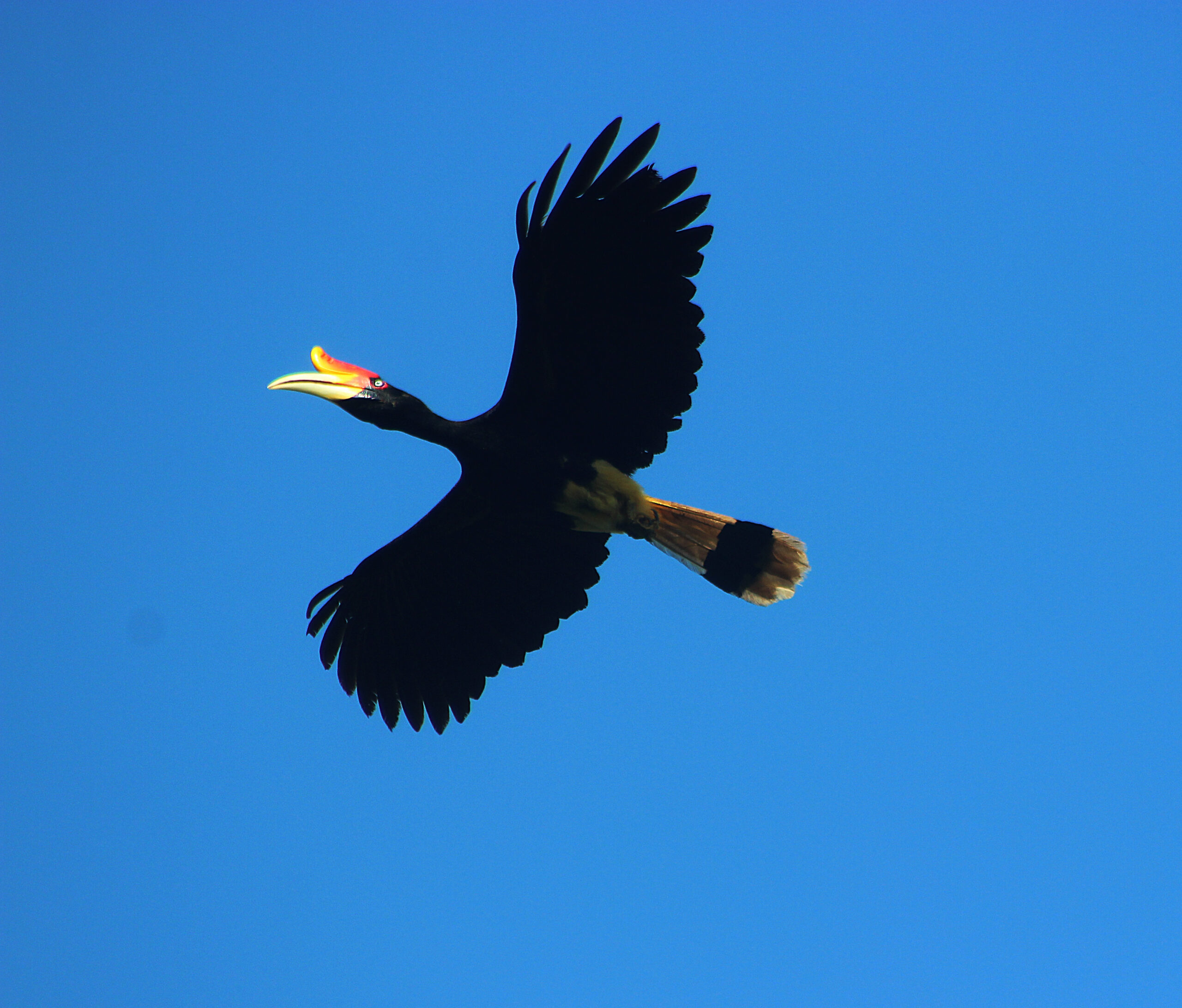
Hornbills are a compelling starting point for learning about Leuser’s birds. A survey conducted in Krueng Tripa, Gayo Lues, between March and June 2018 recorded five species: black hornbill (Anthracoceros malayanus), great hornbill (Buceros bicornis), rhinoceros hornbill (Buceros rhinoceros), helmeted hornbill (Rhinoplax vigil), and wreathed hornbill (Rhyticeros undulatus). This is a record from that study area, rather than a checklist for Back to Nature or a promise of sightings in Bukit Lawang. [2]
Their importance reaches beyond their appearance. Fruit-eating hornbills help disperse seeds, contributing to forest regeneration. Protecting birds also means protecting the trees that feed them and the mature forest that provides shelter and nesting opportunities. [3]
Other birds in local accounts
Bukit Lawang’s local visitor information names barbets, woodpeckers, the great argus and the Malaysian honeyguide among the birds of the national park. This is a useful introduction, although a visitor-information page is a different kind of evidence from a field survey with stated dates and methods. It does not establish how common each bird is, or where a reader might encounter it today. [4]
From a sighting to a reliable record
A useful observation includes more than a species name. Record the date, approximate location, habitat and behaviour. Note whether the bird was seen or only heard. A photograph or sound recording may help another observer review an identification; when the evidence is unclear, leaving the species unidentified is better than assigning a confident name.
The same approach applies to small private forests around Bukit Lawang. A regional species list provides context, but a local checklist needs local evidence. Records from different places and dates should remain distinguishable. A bird documented in Gayo Lues is part of the wider Leuser story; its presence in a particular forest near Bukit Lawang requires a separate observation.
Watch gently, and leave birds undisturbed
Give birds space. Stay on agreed routes, keep voices low, and avoid feeding, chasing or approaching nests. Observation should take priority over drawing birds closer with recorded calls. A distant view is still a worthwhile encounter; a photograph is never more important than the animal’s behaviour.
Conservation is part of this story too. WCS documented helmeted hornbill poaching and illegal trade connected to the Leuser landscape in 2015. That historical case illustrates why wildlife protection matters alongside habitat protection. [5]
A forest understood one observation at a time
A list of names is only the beginning. The more revealing questions concern the place behind each record: the habitat, the trees, the date, the observer and the evidence. Keeping those details makes a story about birds useful to the next person who reads it.
The next unfamiliar call need not become an instant identification. It can become a question worth following: listen, observe, record, and compare. That is how a passing encounter begins to contribute to a better understanding of the forest.
Sources and further reading
- Leuser Conservation Forum — an introduction to the Leuser landscape and its habitats.
- Fithri, A., Priyandika, R., Masykur & Suryawan, F. (2018). Inventarisasi Jenis Burung Rangkong (Bucerotidae) di Hutan Krueng Tripa, Kawasan Ekosistem Leuser (KEL), Kabupaten Gayo Lues. Jurnal Bioleuser, 2(3), 86–89. Field survey, March–June 2018.
- BOS Foundation (2021). Rangkong, Penyebar Benih di Kehje Sewen. Used for general seed-dispersal ecology; the article’s field location is in Borneo.
- BukitLawang.com: Birds. Local visitor information, not a systematic field survey.
- Wildlife Conservation Society (18 June 2015). Traders of One of Indonesia’s Most Hunted Bird Species Arrested. Historical conservation case.